
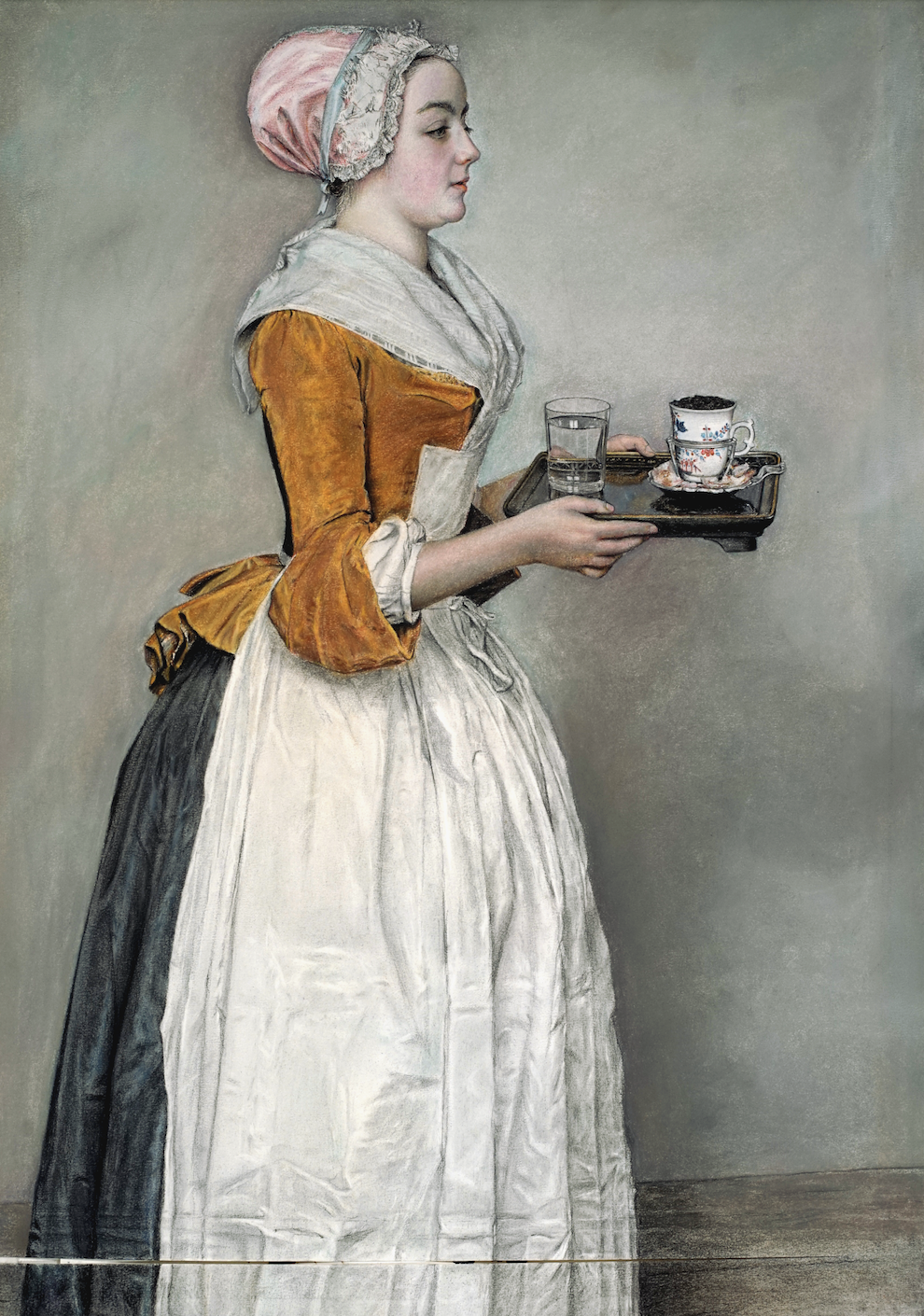
The Chocolate Girl (after Jean-Étienne Liotard, c. 1744), pastel on paper, pressage (blind embossing on paper), 52.5 × 83 cm, 2024
S V E N J A S C H Ü F F L E R
DAS SCHOKOLADENMÄDCHEN VON BERLIN
VERWUNDETE MEISTERWERKE
VERNISSAGE
Sa., 24 October 6-10pm
Dear friends of fresh art,
We are delighted to present our upcoming exhibition The Chocolate Girl of Berlin – Wounded Masterpieces by Svenja Schüffler.
We invite you to discover familiar masterpieces from a new perspective and join us in exploring art and its history through a fresh lens.
We warmly invite you to the exhibition opening at Galerie Kuchling on Saturday, October 24, 2026, from 6 to 10 pm.
We look forward to an inspiring evening, engaging conversations, and seeing you again!

Head of a Stag, Killed by an Arrow (after Albrecht Dürer, 1471–1528), watercolor and pastel on paper, wooden arrow with glass fletching, 45 × 30 cm, arrow: 30 cm, 2024
What Do We Actually Know About a Work of Art?
Reflections on the Exhibition by Josephine Müller, Art Historian
What do we actually see for ourselves?
What do we know because a museum tells us so?
When does a copy become an appropriation?
Who decides what constitutes an original, a masterpiece, or a canonical work?
And what happens to this authority when Svenja Schüffler wounds what is supposedly untouchable?
The Chocolate Girl of Berlin – Wounded Masterpieces begins precisely where art-historical certainties start to falter. The title itself introduces an initial moment of uncertainty. Jean-Étienne Liotard’s famous The Chocolate Girl (1743–45) is among the best-known works in Dresden’s Gemäldegalerie Alte Meister. Yet Schüffler places a Chocolate Girl of Berlin alongside it with an almost casual sense of certainty.
For a moment, uncertainty arises.
Does the title refer to another work? A copy? An appropriation? Could there be another Chocolate Girl that I simply do not know?
It is precisely this uncertainty that captures my interest. Schüffler’s works draw upon images that have long since become part of our cultural memory. Dürer’s Young Hare (1502), Liotard’s The Chocolate Girl, and other canonical works appear familiar to us – reproduced, described, catalogued, and situated within institutional contexts countless times.
Yet familiarity is not the same as certainty.
What we believe we know about these works is not based solely on what is visible before our eyes. Attributions, dates, provenances, and art-historical classifications emerge through research, historical transmission, and institutional authority. Museums preserve works of art, but they also communicate the knowledge through which we interpret and perceive them.
For me, this is where a crucial intersection emerges between the visible object and what we know about it. Schüffler repeats the familiar appearance of the original, alters it, or inflicts wounds upon it. And I find myself asking: What remains of a masterpiece’s authority when its familiar appearance is repeated, altered, or wounded?
Appropriation, however, is only the beginning.
In the series SACRIFICE – What is worth more, Art or Life?, Schüffler takes this exploration a step further. Her images are not merely altered through painting. They are pierced, scratched, struck, painted over, or wounded by gunfire. The act of wounding is not simply depicted – it is carried out upon the work itself.
Appropriation becomes a physical intervention, transforming the supposedly untouchable masterpiece into a vulnerable object.
But what, exactly, is being wounded here?
Not the historical original. Schüffler’s intervention affects her own appropriation, yet the wound touches something that extends beyond the object before our eyes. The authority of a masterpiece, it seems, is not bound solely to its original material substance. It also resides in its recognisability and in the cultural knowledge we associate with it.
Reproduced, exhibited, described, and canonised over centuries, these images circulate – and with them the notions of significance, value, and authority associated with the original.
We know that the original is not being harmed. And yet the intervention may still feel like a transgression.
So what is being sacrificed?
Perhaps, as I see it, it is not only the masterpiece itself that is sacrificed, but also the certainty with which we approach it.
Yet within this series, the act of wounding is not the final step. Some works withdraw from view in another way. An additional work is concealed, removed from public view, and made accessible only under certain conditions. Alongside the visible wound comes the withdrawal of visibility itself.
Encountering the concealed work takes on something of the character of an audience granted by special permission. The work exists, yet its visibility cannot be taken for granted. As with a reliquary, a particular significance emerges precisely from the relationship between visibility and concealment.
What happens to a work of art when we know it exists, but its visibility is subject to certain conditions?
Knowledge and sight become separated. The existence of the concealed work is known, yet its appearance is not readily accessible. What can we know about a work of art when the work itself is not fully available to us?
This engagement with knowledge and uncertainty is not limited to art in Schüffler’s thinking. Her scientific background informs an approach in which gaining knowledge does not necessarily eliminate uncertainty. More precise methods, more accurate measurements, and new findings may confirm what was previously considered established – or call it into question.
For me, this also reveals a parallel with art history. Attribution, dating, provenance, and canonisation are not inherent properties of a work of art. They are the results of research, comparison, historical transmission, and interpretation – and are therefore open to verification, correction, and change.
The object may remain materially unchanged – while our knowledge of it changes.
Seen in this light, Schüffler’s works make this mutability visible by disrupting the familiar order of images. Copy and appropriation, preservation and wounding, visibility and concealment do not stand in simple opposition to one another. Instead, they overlap.
Perhaps the act of truly looking begins precisely where recognition is no longer enough.
The Chocolate Girl of Berlin – Wounded Masterpieces therefore offers no definitive answers. What initially appears to be a question of original and copy becomes a question about our own ways of seeing and knowing.
What do we recognise for ourselves?
What do we accept through historical transmission and institutional attribution?
And what remains of our certainty when the familiar is wounded, concealed, or given a new name?
Perhaps this is precisely where the significance of Schüffler’s work lies. Her works do not deprive us of art-historical knowledge.
They merely strip it of its apparent self-evidence.